Why the Brain Replays Negative Thoughts (And What to Do About It)
By Piyush Wadhwa · February 27, 2026
What It Means When the Brain Replays Negative Thoughts
The brain replays negative thoughts because it is wired to treat unresolved threats as ongoing priorities. This is not a malfunction, it is a deeply embedded survival mechanism that keeps potentially harmful experiences active in memory until the brain perceives the threat as resolved. For analytical thinkers in particular, this mechanism gets hijacked by abstract problems, social situations, and future scenarios that have no clean resolution.
The Neuroscience Behind the Loop
Understanding why the brain replays negative thoughts starts with understanding what the brain is actually doing when it runs those loops. It is not being irrational. It is following a set of internal rules that made a great deal of evolutionary sense, just not always in the context of modern professional life.
The Default Mode Network
When you are not focused on an external task, your brain activates a cluster of regions called the default mode network (DMN). This is the system responsible for self-referential thinking: replaying past events, imagining future scenarios, and constructing a sense of personal narrative. Research consistently shows that people with high levels of rumination have elevated DMN activity even when they are trying to focus on something else. The DMN is not broken in overthinkers, it is overactive, and it defaults to unfinished emotional business.
Negativity Bias
The brain does not treat positive and negative experiences symmetrically. Negative events are encoded more deeply, recalled more easily, and given more cognitive weight than equivalent positive ones. This is negativity bias, and it exists because underestimating a threat historically carried higher costs than underestimating an opportunity. Missing a chance for food is recoverable. Missing a sign of danger is not. Your brain still operates on that logic, which is why a single critical comment from a colleague can replay for days while a dozen compliments fade within hours.
Memory Consolidation and the Amygdala
The amygdala flags emotionally significant events for deeper encoding. When an experience carries a strong negative emotional charge, embarrassment, conflict, failure, uncertainty, the amygdala essentially tells the hippocampus: this one matters, store it clearly. During sleep, and again during idle waking states, the brain returns to these flagged memories. It is attempting to process and integrate them. When the emotional charge of a memory has not been resolved, the brain keeps returning to it, not out of dysfunction, but out of an incomplete process.
Rumination vs. Reflection: A Key Distinction
These two words are often used interchangeably, but they describe fundamentally different cognitive processes. Conflating them leads people to either over-pathologize normal thinking or mistake unproductive loops for useful analysis.
| Rumination | Reflection | |
|---|---|---|
| Direction | Backward-focused, looping | Forward-oriented, progressing |
| Goal | No clear resolution sought | Aimed at understanding or decision |
| Emotional tone | Distress, self-criticism, shame | Curiosity, mild discomfort, openness |
| Outcome | Increased anxiety, no insight | Insight, closure, adjusted behavior |
| Time structure | Open-ended, no natural stop | Bounded, reaches a conclusion |
| Common trigger | Threat to self-concept or social standing | Desire to learn or course-correct |
Rumination is passive repetition. Reflection is active processing. The brain engages in both, but only one of them serves you. Overthinkers frequently mistake high-intensity rumination for productive analysis, the mental effort feels like work, but no actual progress is being made.
The Four-Part Loop: Why Negative Thoughts Stick
To understand why certain thoughts replay repeatedly, it helps to see the mechanism as a loop rather than a single event. The following model, 'the Replay Loop' breaks down the four conditions that sustain negative thought repetition.
1. Trigger A stimulus activates a memory or concern. This can be external (a message, a look, a news headline) or internal (a passing thought, a physical sensation). The brain matches the current input to a stored pattern that previously carried threat.
2. Threat Appraisal The brain evaluates whether the trigger represents a real or potential danger , to safety, status, identity, or belonging. For analytical minds, this appraisal is often thorough and recursive: what does this mean, and what does that meaning mean? This is where overthinking begins to compound.
3. Unresolved Status If the threat cannot be neutralized, either because it involves the past (unchangeable), the future (uncontrollable), or other people's inner states (unknowable), the brain flags it as unresolved. Unresolved items are kept active. The loop does not close.
4. Reactivation During low-stimulation states, waiting, lying awake, commuting, the gap between tasks, the brain returns to unresolved items. Each reactivation can feel like the threat is fresh, which re-triggers appraisal, and the loop continues.
The loop does not persist because you are weak-willed or neurotic. It persists because the brain has not received a signal that the threat is resolved.

How to Interrupt the Replay: A Practical Process
The goal here is not to suppress negative thoughts, suppression reliably increases the frequency of intrusive thinking. The goal is to give the brain what it is actually looking for: resolution, or a credible substitute for it.
1. Name the loop explicitly When you notice a thought replaying, label it: this is a replay. Not "I'm overthinking again", that framing adds self-criticism to an already active threat response. Just: this thought is replaying. Naming activates the prefrontal cortex, which helps modulate the amygdala's response. It creates a small but functional distance between you and the content of the thought.
2. Identify what type of unresolved item it is Ask yourself: is this thought about something that can be resolved with action, or is it about something that cannot? Most looping thoughts fall into three categories, things that already happened and cannot be changed, things that might happen and cannot be controlled, and things that depend on variables outside your knowledge. Knowing which category you are in is not a cure, but it stops the brain from treating all three as problems that require more thinking.
3. Give the brain a structured closure signal The brain loops because it has not received resolution. You can create a partial resolution through deliberate action: write the thought down fully (externalizing reduces the need for internal repetition), make a concrete decision about it (even a decision to revisit it at a specific time), or articulate the worst-case outcome plainly. Counterintuitively, clearly naming the feared outcome often reduces the loop's intensity. Vague dread is harder for the brain to process than a specific, named concern.
4. Reduce idle mental time with intention Unstructured, low-stimulation time is when the DMN is most active. This does not mean you should fill every moment with stimulation, that creates its own problems. It means that if you know you are in a high-loop period, having a specific anchor activity during transition states (commuting, before sleep, between tasks) can reduce unsolicited replay. Something that requires mild attention, reading, a structured walk, a short protocol, is usually more effective than passive distraction.
5. Distinguish processing from replaying Sometimes the brain replays because it has more to process. Give it one bounded window, fifteen to twenty minutes, to think the thought through fully and deliberately. Write. Think. Speak aloud if that helps. Then close the window. This is not avoidance; it is teaching the brain that the thought has a place and a time, which reduces its urgency outside that window.

Common Misconceptions About Overthinking and Negative Thought Loops
"If I just stop thinking about it, it will go away." Thought suppression is one of the most consistently counterproductive strategies in cognitive psychology. Trying not to think about something increases its cognitive accessibility. The goal is not suppression but structured engagement.
"Replaying bad memories means I haven't moved on." Replay is not a sign of insufficient willpower or emotional failure. It is a sign that the brain has flagged something as unresolved. The replay is the brain doing its job, the question is whether the processing strategy is effective.
"Overthinkers just need to be more positive." Negativity bias is neurological, not attitudinal. Telling someone with an active threat-detection system to think more positively is roughly equivalent to telling someone with acute hearing to stop noticing loud sounds. The mechanism needs to be understood and worked with, not overridden by optimism.
"Talking about it always helps." For some people, talking is a processing tool. For others, particularly those prone to co-rumination, discussing a looping thought with someone who is also anxious or unresolved about it can amplify rather than reduce the loop. The context and quality of the conversation matters significantly.
When to Consider Professional Support
Negative thought loops are a normal part of human cognition. But when they are persistent, significantly interfering with sleep, work, or relationships, and do not respond to structured self-management over time, that is worth taking seriously.
Chronic rumination is one of the most reliable predictors of depression and anxiety disorders. If your thought loops are accompanied by persistent low mood, inability to concentrate, physical symptoms of anxiety, or a sense that the loops are accelerating rather than stabilizing, a conversation with a psychologist or therapist is appropriate, particularly one familiar with cognitive behavioral therapy (CBT) or its more structured variants like MBCT.
This is not an escalation. It is an efficient use of the right tool for the job.
Summary
- The brain replays negative thoughts because it treats unresolved threats as active priorities, this is a survival mechanism, not a character flaw.
- Negativity bias and the default mode network mean the brain will naturally return to unprocessed emotional material during idle states.
- Rumination and reflection are distinct processes; only reflection produces resolution.
- Thought suppression worsens loops. Structured engagement, naming, categorizing, and creating closure signals, is more effective.
- Persistent, escalating loops that affect daily function are worth addressing with professional support.
FAQs
The brain encodes negative experiences more deeply than positive ones due to negativity bias, an evolutionary adaptation that prioritized threat detection over opportunity recognition. Negative memories are more accessible and more likely to be reactivated during idle mental states, which is why a difficult conversation tends to replay more readily than an enjoyable one.
Not necessarily. Negative thought replay is a normal cognitive process that most people experience. It becomes clinically relevant when it is chronic, uncontrollable, and significantly disrupts daily functioning. Occasional replay in response to stressful events is within the normal range of human cognition.
During sleep onset and light sleep stages, the brain shifts into default mode and begins consolidating emotionally significant memories. Unresolved items are reactivated for processing during this time. This is why anxious or difficult thoughts often intensify when you are lying in bed, it is not coincidence, it is the memory consolidation process operating without daytime distractions to suppress it.
Overthinking refers to a cognitive style characterized by excessive, repetitive analysis. Anxiety is a broader emotional and physiological response that includes overthinking as one component. Overthinking can exist without a clinical anxiety disorder, though the two frequently overlap. The key distinction is that anxiety involves a sustained stress response in the body, while overthinking can be primarily cognitive without significant physical symptoms.
You can train your brain to engage with negative thoughts differently, which reduces their frequency and intensity over time. Techniques grounded in CBT, metacognitive therapy, and mindfulness have consistent research support for reducing rumination. Complete elimination of negative thought replay is neither realistic nor the goal, reducing its disruptiveness and duration is.
Each reactivation of a negative thought can feel emotionally immediate because the amygdala processes emotional memory in a way that partially recreates the original physiological state. The thought does not just represent the past event, it briefly re-creates something of its emotional texture. This is why replay can feel urgent and real even when you intellectually know the situation is resolved.

Piyush Wadhwa
Piyush Wadhwa writes for the ones who think too much, feel too deeply, and pretend to have it all figured out. Through Overthinker's OS, he turns late-night thoughts into words that help you pause, laugh, and make peace with your mind — one page at a time.
You May Also Like
Overthinking
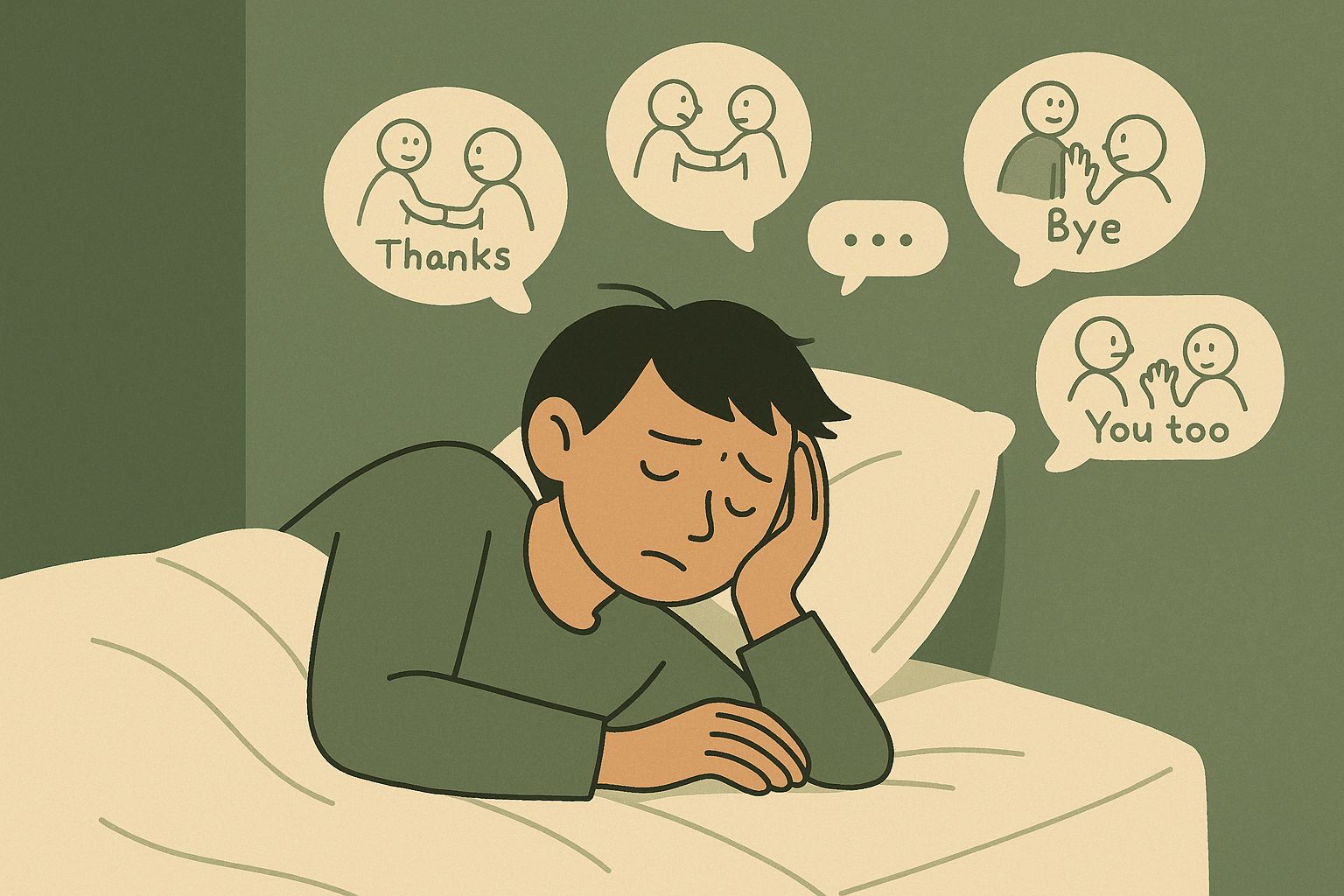
8 Times You Replayed a Conversation That Didn’t Even Matter
8 Times You Replayed a Conversation That Didn’t Even Matter
Piyush Wadhwa·October 25, 2025
Overthinking
9 Thoughts Every Overthinker Has Before Sending a Simple Text
9 Thoughts Every Overthinker Has Before Sending a Simple Text
Piyush Wadhwa·October 25, 2025
Health & Wellness
Do They Actually Like You or Are You Just Filling in the Blanks?
Do They Actually Like You or Are You Just Filling in the Blanks?
Piyush Wadhwa·October 25, 2025