Do They Actually Like You or Are You Just Filling in the Blanks?
By Piyush Wadhwa · October 25, 2025
You know that feeling when someone gives you just enough attention to make you wonder if it means something?
A few texts, a few jokes, a few perfectly timed smiles, and suddenly your brain starts writing a romantic story it was never asked to write.
It’s not that they said they like you.
It’s just that they didn’t say they don’t.
And your imagination filled in the rest.
That’s what overthinkers do best. We take fragments of reality and turn them into emotional documentaries no one asked for.
The tiny breadcrumbs that start it all
It always begins with something small.
A compliment that lingers a little longer than it should.
A message that ends with a smiley instead of a full stop.
A question that feels more personal than necessary.
Your rational mind says, “They’re just being nice.”
Your emotional mind whispers, “But what if it’s more?”
And then, before you know it, you’re analyzing typing speed, punctuation style, and emoji frequency like it’s evidence in a mystery case.
The real problem isn’t overthinking, it’s storytelling
We don’t fall for people first.
We fall for the stories we build about them.
We take half sentences and random gestures and turn them into meaning.
We create patterns where there might be none.
It’s not madness, it’s how humans are wired.
Our brains crave coherence.
We can’t stand an unfinished puzzle, so we fill in the missing pieces with imagination.
Sometimes the pattern is real.
Other times, it only exists in our heads.
Maybe they’re kind, not curious
Sometimes people are just nice.
They reply quickly because they’re polite.
They check in because they care, but not because they’re interested.
For an overthinker, kindness can feel like connection.
For the other person, it might just be conversation.
That’s how mixed signals are born — one person is just being friendly while the other is decoding every syllable for signs of affection.
Signs you might be filling in the blanks
If any of these sound familiar, you might be building a story out of half clues.
-
You reread their messages to study tone or hidden meaning.
-
You imagine their side of the story — what they meant, how they feel, what they’re thinking now.
-
You get small dopamine hits from generic texts like “haha yeah.”
-
You feel weirdly low when they take longer to reply.
-
You tell friends “it’s not serious” while secretly hoping it becomes serious.
-
You excuse inconsistent effort by saying “they’re just busy.”
It’s not that you’re foolish.
It’s that your brain wants clarity in a world full of maybes.
Why we do this
Uncertainty makes overthinkers itch.
We’d rather create a false sense of closure than sit with the unknown.
So we fill in the blanks.
We make up explanations, connections, and possibilities that make the situation feel less vague.
Even if the story isn’t true, it feels safer than silence.
Because silence feels like rejection waiting to happen.
What real interest looks like
People who actually like you make it obvious.
You won’t need to decode tone or read between the lines.
Real interest feels steady.
It won’t leave you guessing.
It won’t make you check timestamps or overanalyze punctuation.
You won’t feel like you’re auditioning for their attention.
You’ll just feel… calm.
That calmness is the proof you’ve been looking for all along.
The heartbreak of “almost”
The hardest heartbreak isn’t losing someone you loved.
It’s realizing you were never in the same story together.
They were just a character in your version of the script.
You were the only one who thought it was a love story.
That realization stings, but it’s also freeing.
Because you can finally stop writing chapters in someone else’s silence.
How to stop filling in the blanks
You don’t have to stop caring. You just have to stay aware.
Pause before assuming. Ask yourself, “Did they actually say or do something clear, or did I fill that in myself?”
Look for effort, not excitement. Energy can be thrilling but inconsistent. Effort is quieter but real.
Let people write their own side of the story through their actions. Don’t keep editing their part.
Notice how you feel. If it’s calm, it’s probably mutual. If it’s chaotic, it’s probably imagined.
And if it’s still unclear, that’s your answer too. Clarity doesn’t hide.
Final thought
Maybe they don’t like you the way you hoped.
Maybe they do, but not enough to show it clearly.
Maybe they were never trying to make you guess in the first place.
Whatever the case, you don’t have to keep connecting dots that aren’t there.
You deserve a story that doesn’t need decoding.
Next time your brain starts filling in the blanks, stop and ask yourself:
Are you drawn to the person, or the story you’ve built around them?
Because stories fade.
But peace of mind — that stays.

Piyush Wadhwa
Piyush Wadhwa writes for the ones who think too much, feel too deeply, and pretend to have it all figured out. Through Overthinker's OS, he turns late-night thoughts into words that help you pause, laugh, and make peace with your mind — one page at a time.
You May Also Like
Overthinking
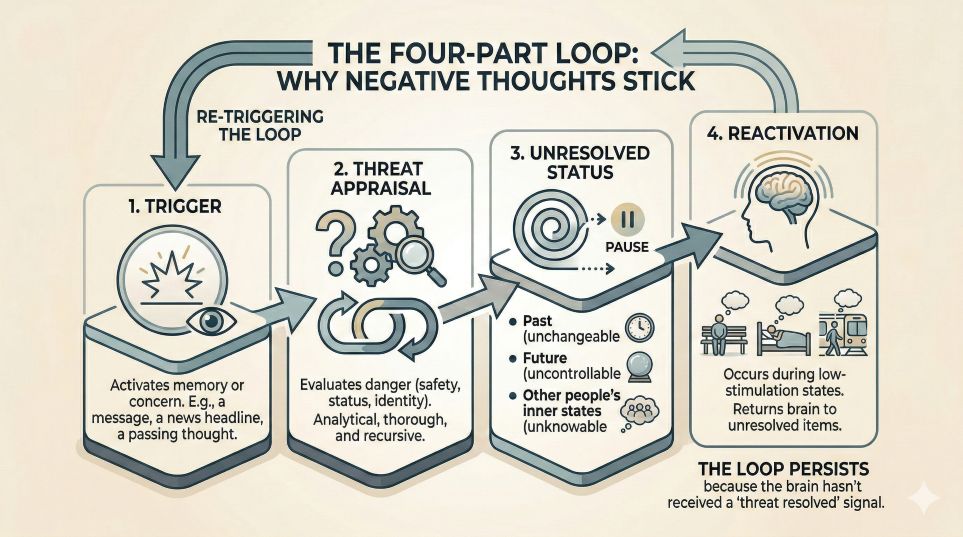
Why the Brain Replays Negative Thoughts (And What to Do About It)
The brain replays negative thoughts because it treats unresolved experiences as active threats. Learn the neuroscience behind the loop and how to interrupt it.
Piyush Wadhwa·February 27, 2026
Overthinking
8 Times You Replayed a Conversation That Didn’t Even Matter
8 Times You Replayed a Conversation That Didn’t Even Matter
Piyush Wadhwa·October 25, 2025
Overthinking
9 Thoughts Every Overthinker Has Before Sending a Simple Text
9 Thoughts Every Overthinker Has Before Sending a Simple Text
Piyush Wadhwa·October 25, 2025